At the beginning of March this year, I got a call from the agent asking whether I’d be interested in the part of Sir Wilfrid Robarts in Witness for the Prosecution, the hit show parked in the glorious old County Hall on the South Bank. According to the agent, the latest cast were already half way through rehearsals but the actor playing Sir Wilf had been forced to drop out – & the production team were keen for a quick response. Following a pregnant pause of approximately one second, I replied calmly:
“Hell yeah!!”
Some context
Sir Wilfrid rocks. No actor in his right mind would turn him down. I’ve known Sir Wilfrid on & off for a few years now – but my relationship with him has deepened significantly over the last half year. Sir Wilf is Queen’s Counsel for the Defence in the Central Court of Oyer & Terminer (I have no idea, look it up), is fizzy, charming, debonair, valiant champion of the underdog, total hero, total peacock. Also, crucially, he simply adores the sound of his own cut-glass voice. Which, for the last six months, has been my voice. It’s been a thoroughly mutual love-in between the two of us, let’s say. For half a year, I get Sir Wilf’s whip-smart 1950s legalese as refracted through the textual lens of Agatha Christie & Mike Poulton – & he gets my sweaty double chin & utter mid-career delight.
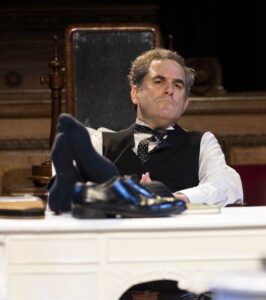
Sweaty chin
Some more context
Witness for the Prosecution is one of Agatha’s redoubtable theatrical mainstays involving a brutal murder, a German femme fatale & an unflinching examination of the various smug complacencies of the post-war British legal system. More than that it’s tricky for me to reveal due to various prohibitions under the Official Secrets Act. What I can tell you is that this particular court-room drama is staged in an actual courtroom: the grand old debating chamber in London’s County Hall, a gorgeous Edwardian baroque vision bedecked in Portland stone – aswell as erstwhile home to London local democracy. Every night, actors & audience jostle with the ghosts of twentieth century politicians up to & including Ken Livingstone in the 1980s … engaging, you may remember (if you’re of a certain vintage), in droningly nasal rhetorical battle with Thatcher & her Winkie Guards on the opposite bank of the river.

Nasal drone
Discovered beneath a substantial layer of dust & Japanese ownership in 2016 by producers Rebecca Stafford & Eleanor Lloyd, the debating chamber was given a vigorous spring clean & an integrated sound system – & thence was transformed into the set of what would become a sizeable commercial & critical hit directed by the mighty Lucy Bailey, a set on which the audience become active participants: jurors sworn in to cast judgement on a young chap called Leonard Vole who stands accused of murder. It’s a brilliantly simple theatrical device – & has secured the show’s place in the landscape of London theatre since it first opened in 2017.
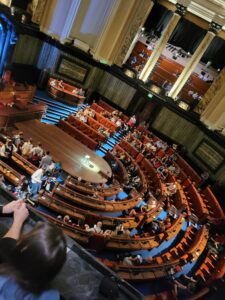
Gorgeous
I’m in cast number seven (they have a clear-out every six months to prevent mold) & number eight will be taking over in a few weeks time. So as a goodwill gesture to my successor, Dugald Bruce Lockhart – & indeed all Sir Wilfrids stretching into the far-flung future (it is a certainty upon which it is worth staking one’s soul that when the world is but a smouldering rock circling the sun & civilisation has been reduced to two old women bickering in a cave, Witness for the Prosecution will still be playing on the South Bank) – this is my Quick Set-up How-To guide, should anyone find themselves blessed with this fabulous gig.
Sir Wilf: Quick set-up
1. Remove from packaging. Find script. Start. Learning. It. Immediately. On no account should you wait until the first day of rehearsal – there won’t be enough time. Sir Wilfrid has a lot to say for himself. Gnawing your own knuckles as you contemplate making a quick & permanent incognito escape to France on opening night because you’re not 100% on the lines is frankly too high a price to pay for ‘feeling your way into the part’. If all else fails, Sir Wilf gets to take an impressive looking note-book containing his ‘notes for the defence’ into court with him. Scribble your lines in that. No-one will notice.
2. Get fit. Sir Wilf does lots of scampering around the outside of the chamber, climbing into & out of coat, cloaks & wigs – all at speed whilst feverishly whispering his next line in the ensuing scene just to check it’s still there & hasn’t wandered off & got lost in the building somewhere.
3. If you’re incredibly lucky, you’ll have Corrie Darling as your dresser helping you in & out of all that clobber with the soothing balm of a deity bathed in light. As you prepare to step into the hushed dazzling void with all the calm assurance of a desperate man about to throw himself from a window, Corrie makes everything alright. If Mother Teresa & Darcy Bussell had had a baby who was a whizz with a sewing-machine, they would have called her Corrie. Make sure you have a Corrie. Sir Wilf basically doesn’t work without one.
4. Delight in Sir Wilf’s surprisingly dark undercurrents. For such a genial sort heroically holding true to a much-cherished sense of fair play, his innate decency often seems to bump up against a surprising arrogance, misogyny, reflexive xenophobia & petulance. I found him sneering the other day. I was quite shocked. But I went with it. Like all great inventions, he contains multitudes.
5. Accept the idea of cake. Huge amounts of it. There’ll always be someone in the cast who will have bought/made/nicked one for the green room table. Jane Lambert from a previous cast has acquired mythic status in the ever-expanding Witness circle for contributions in that department. Sir Wilf will grow a belly. Don’t fight it. Corrie can always help with the waist-band.
6. Never reveal the twist to a member of the public. Something unspeakable will happen to you courtesy of the production staff involving a cosh. Or a crow-bar.
7. Try not to get lost backstage while going to the loo during the interval. The ‘Witness’ part of County Hall backs on to the ‘Shrek Experience’ part. It doesn’t bear thinking about.
8. Love your audience. A lot of them are tourists just off the plane. To you it’s high-end heritage theatre – to them it’s King Lear with some murder mystery thrown in. And they’d be right. Audiences always are. Bask in those regular standing ovations. You wouldn’t get them from the stuffed shirts next door at the National.
9. Prepare to get COVID.
10. As far as Sir Wilfrid is concerned, appreciate that the play is ultimately about the shattering of illusions & the puncturing of an inflated sense of self when brought up hard against the reality of a cold, brutal world. As far as you’re concerned, enjoy your bubble of theatrical delight while it lasts & get ready for unemployment.
Hope this helps, Dugald. Wishing you all the best. You’ll have a blast.
Owen.
PS: This is in case you ever get lost:
Haha brilliant read!
Thanks Craig! 👍😊